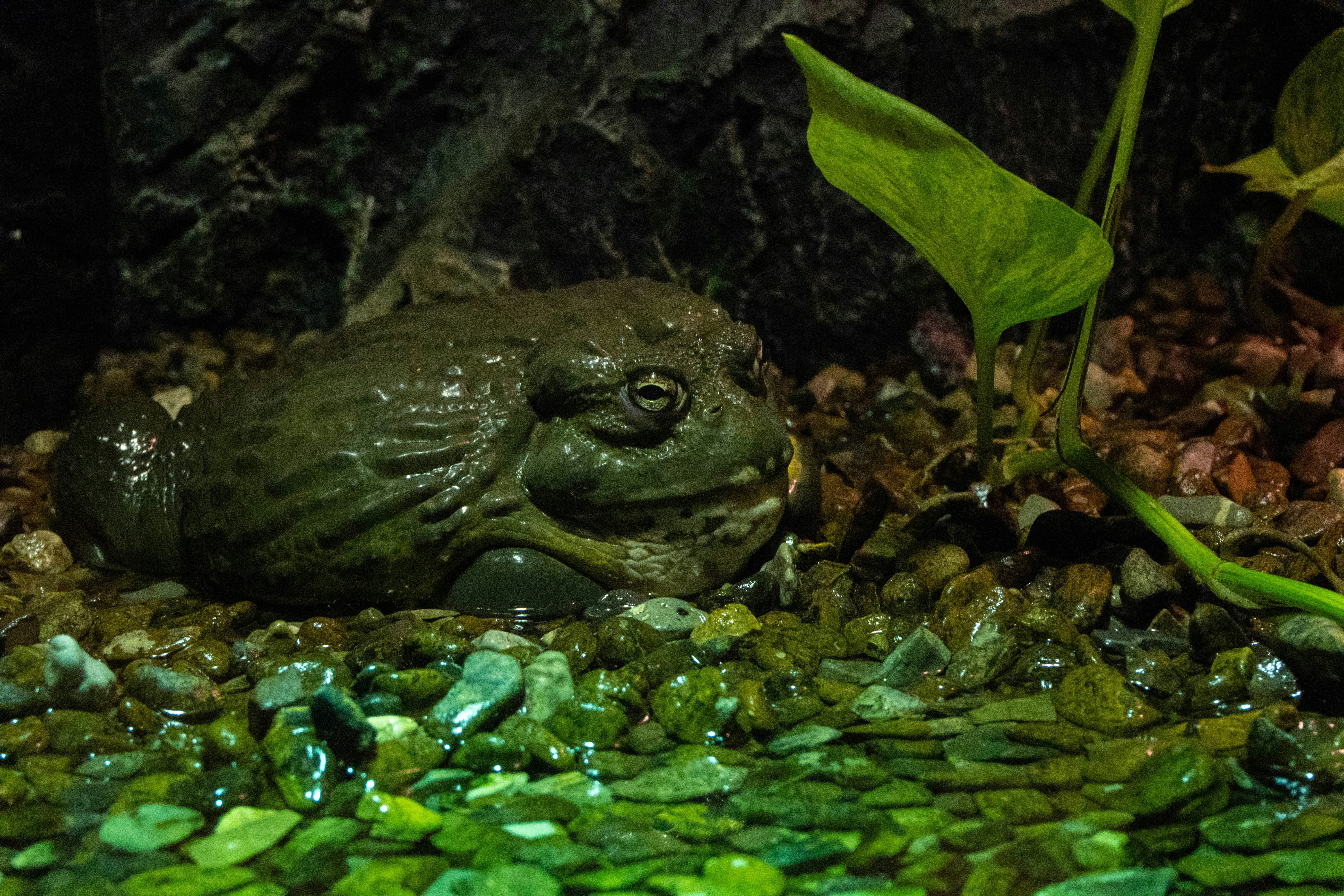
African Bullfrog
Scientific name: Pyxicephalus adspersus
Large, very robust frog with voracious appetite, native to savannas and semi-arid zones.
Quick facts
- Approximate size15–25 cm
- Average weight0.5–2 kg
- Life expectancy20–40 years
- ActivitySeasonal
Scientific name: Pyxicephalus adspersus
Large, very robust frog with voracious appetite, native to savannas and semi-arid zones.
What this species is like in its natural environment, with the climate, shelters and resources it needs.
The African bullfrog is one of the largest anurans, adapted to cycles of intense rainfall and long droughts.
Takes advantage of temporary ponds in grasslands and savannas; the rest of the year it remains buried underground in dormancy.
During rains it emerges, feeds intensively and reproduces; then returns to burrow when water disappears.
Its ability to encase itself in a hardened skin capsule allows it to survive long periods without water.
Some populations are relatively stable, but habitat transformation and capture can affect them locally.
Striking details about this species that help better understand its biology and role in ecosystems.
Summary of the most critical points if this species is kept in captivity at specialized centers.
In captivity needs spacious terrariums with deep substrate and access to a safe aquatic area.
Feeding must be controlled to avoid obesity, common in captive specimens.
Handling should be cautious due to its strength and size; not an animal to handle frequently.
General information intended for professional facilities and educational projects. Not intended to encourage capture or improvised keeping of wild amphibians.
Only recommended for very informed keepers with sufficient space.
It is essential to avoid releasing them in places where they are not native to prevent ecological impacts.
Their presence in educational collections can illustrate extreme adaptations to climates with seasonal rainfall.
This section has an educational purpose. Amphibian conservation involves, above all, protecting ponds, rivers, forests and wetlands, and avoiding irresponsible release of exotic species.