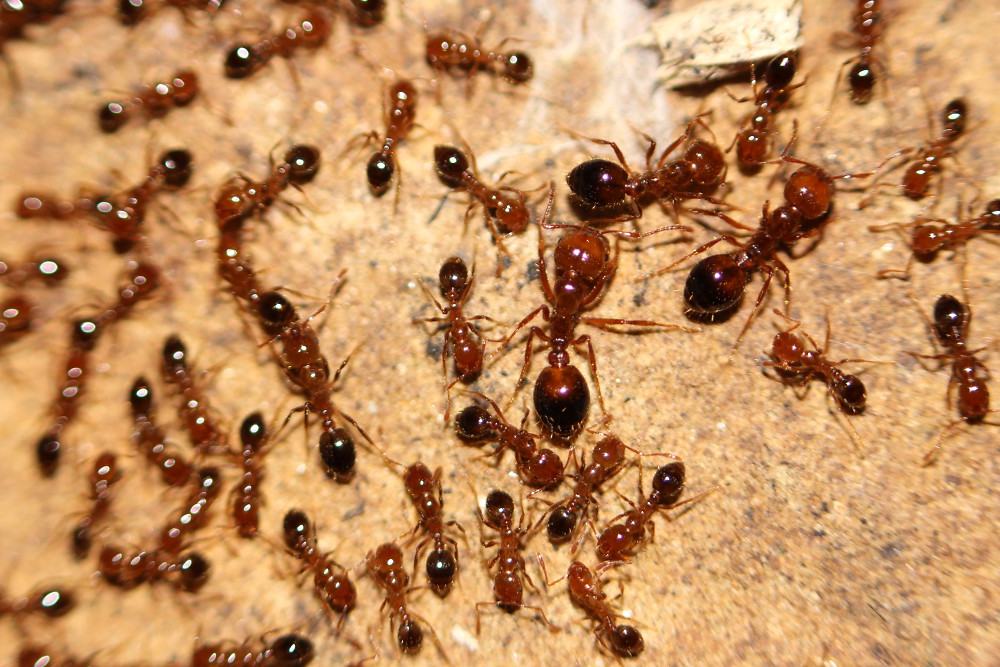
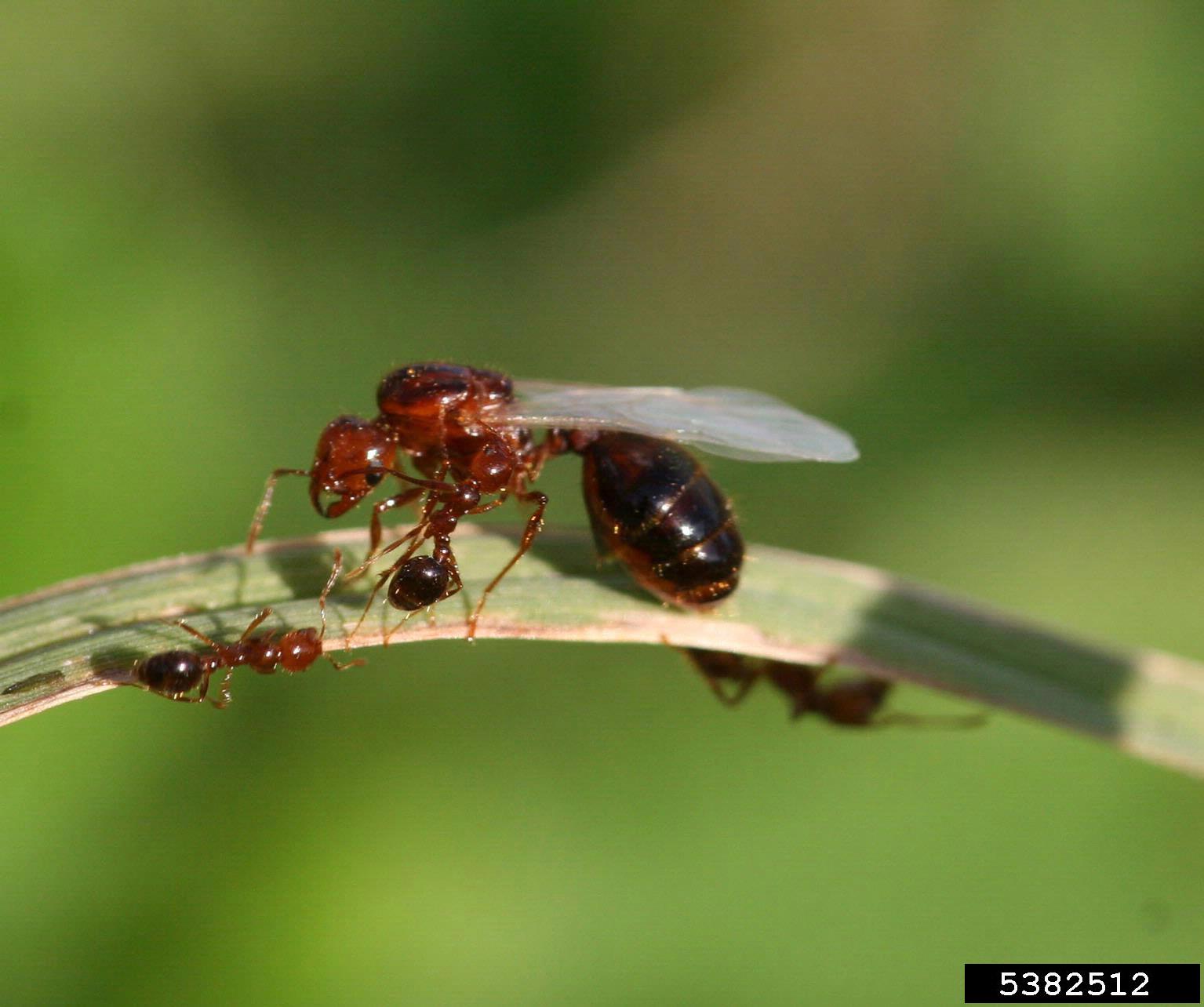
Fire Ant

Scientific name: Solenopsis invicta (como especie invasora famosa)

Type: Insect Main biome: Tropical Jungle Difficulty: Alta

Social insect whose expansion outside its original range causes conflicts with fauna, flora and humans.

Quick facts

  • Approximate size2–6 mm (depending on caste)
  • Average weightVery low; complete colony can weigh several grams
  • Life expectancyWeeks (queens, years)
  • ActivityMainly diurnal, variable depending on temperature
Fire Ant
Fire Ant

Basic information

  • 🏡Habitat: grasslands, agricultural fields, parks, and urban areas in warm zones, where it builds earth mounds.
  • 🍏Diet: omnivorous; consumes invertebrates, seeds, nectar, and human food remains.
  • 👫Sexual dimorphism: well-differentiated castes; large winged queens (in reproductive phase), winged males, and smaller workers.
  • 🐾Predators: some insects, birds, and other animals, but in invaded areas it usually has few species that control it.

Life in the wild

How this species lives in its natural environment, with the climate, shelters and resources it needs.

Species overview

The fire ant is a clear example of the impact of invasive species on ecosystems and human health.

Natural habitat

It prefers loose and warm soils where it can build mounds and expand rapidly.

Behavior

It is very aggressive in nest defense and forms very organized foraging routes.

Special features

Its venom contains alkaloids that cause the characteristic burning sensation in stings.

Conservation and threats

It does not need protection; on the contrary, work is done to control and reduce its populations outside its original area.

Curiosities

Striking details about this species that show its biology and ecology in a different way.

  • 🌿Its stings can cause severe allergic reactions in some people.
  • It forms very dense colonies that displace native ants.
  • 🔎It has been involuntarily transported by international trade.
  • 🧬Its control is costly and complex once established.

Welfare profile

Aspects to consider if this species is kept in captivity in specialized centers.

Space and facilitiesHigh

Its maintenance in captivity is not recommended outside of strictly controlled research contexts.

Environmental conditionsHigh

There is a risk of escapes and establishment if biosecurity measures are neglected.

Handling and stressHigh

Handling for recreational purposes is dangerous for people sensitive to its venom.

Fire Ant in captivity

General information aimed at professional facilities and authorized centers.

⚠️ Before keeping insects like this species, it is important to consult local regulations and always consider whether it is really necessary to remove them from their natural environment.

Suitable facilities

It should only be kept in research facilities with clear containment protocols.

Feeding in responsible centers

Studies focus on control methods, invasive biology, and toxicology.

Handling and welfare

In education it is usually treated as a theoretical example, without keeping live colonies in non-specialized centers.

Ethical message

It is a good case for discussing biosecurity and risks of international species transport.

Imagen ampliada