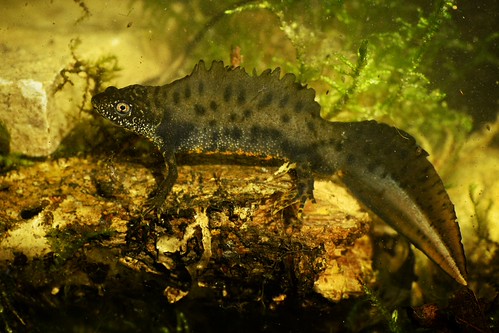
Great Crested Newt

Scientific name: Triturus cristatus

Type: Amphibian Main biome: Rivers and Wetlands Difficulty: Media

Large European newt with very prominent dorsal crest in males during breeding season.

Quick facts

  • Approximate size12–17 cm
  • Average weight10–20 g
  • Life expectancy10–15 years
  • ActivityNocturnal / crepuscular
Great Crested Newt

Basic information

  • 🏡Home: forest and agricultural ponds without fish, surrounded by forests and humid meadows.
  • 🍏Food: aquatic invertebrates in aquatic phase and terrestrial ones when on land.
  • 👫Sexual dimorphism: males develop a large dorsal and caudal crest during breeding season.
  • 🐾Predators: aquatic birds, fish (if present), mammals and other vertebrates.

Life in the wild

What this species is like in its natural environment, with the climate, shelters and resources it needs.

Species overview

The great crested newt is an emblematic urodele of well-preserved European ponds.

Natural habitat

Combines fish-free breeding ponds with humid terrestrial habitats where it spends much of the year.

Behavior

During breeding season remains mainly in water; outside of it is terrestrial and discrete, active on humid nights.

Special traits

Its spectacular crest and mottled patterns make sexual dimorphism very visible during reproduction.

Conservation and threats

Suffers from pond destruction, fish introduction and intensive pesticide use.

Curiosities

Striking details about this species that help better understand its biology and role in ecosystems.

  • 🌧️A protected species in many European countries.
  • Needs relatively deep ponds but without predatory fish to breed successfully.
  • 🔎Males perform elaborate courtship displays in front of females.
  • 🧪Sensitive to agricultural pollution and loss of traditional ponds.

Welfare profile

Summary of the most critical points if this species is kept in captivity at specialized centers.

Facilities and spaceMedium

In captivity needs paludariums with a well-filtered aquatic part and humid terrestrial zones.

Water, light and microclimateHigh

Water quality and absence of contaminants are critical for its health.

Handling and stressMedium

Sensitive to high temperatures and abrupt changes in microclimate.

Great Crested Newt in captivity

General information intended for professional facilities and educational projects. Not intended to encourage capture or improvised keeping of wild amphibians.

⚠️ Amphibians are particularly vulnerable to pollution, emerging diseases and improper handling. Before keeping species like this, it is essential to review local regulations and seek qualified advice.

Suitable facilities

Maintenance should be linked to educational and conservation programs, using captive-bred specimens.

Feeding in responsible centers

  • Diet includes small aquatic and terrestrial invertebrates depending on phase.
  • Tubifex, daphnia, small crickets.
  • Occasional calcium supplementation.

Handling and welfare

Captive breeding requires very controlled conditions and adequate ponds.

Ethical message

Encouraging the creation of amphibian ponds in the field has greater impact than multiplying newts in terrariums.

Imagen ampliada